Advertisements have come a long way from the 50’s in terms of technology, quality, and even the gender roles and stereotypes they depict. Although it has improved, there are still some ways in which old gender stereotypes are reinforced through advertisement today. Below are a few examples of different company’s advertisements and the ways they exemplify certain gender roles and stereotypes.
Oh, how the times have changed.
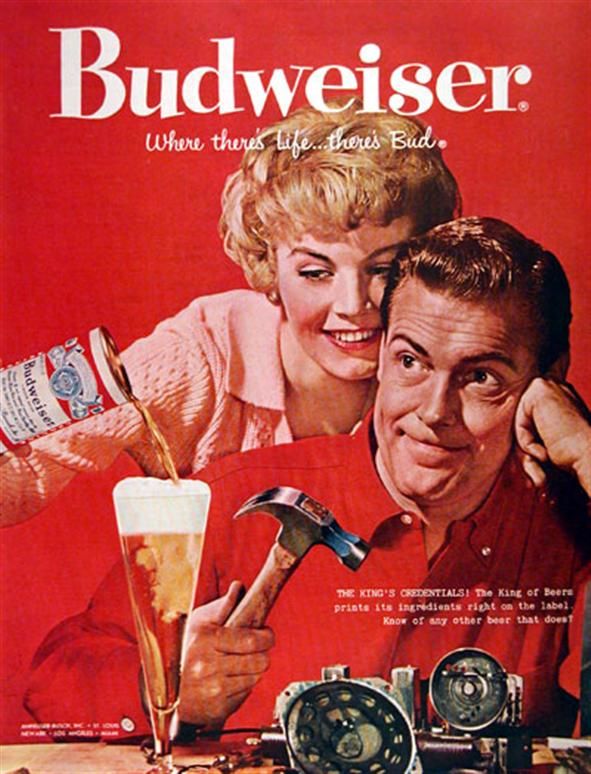
There was a time earlier in the 20th century where the United States of America had a very traditional way of going about things and ensured a specific set of gender roles was adhered to; therein, enforcing specific gender stereotypes. This ad exemplifies the stereotype that women were expected to be subservient to their husbands. That their sole responsibility was to dote on their husband while he is busy pursuing his passions, goals, and career.
This advertisement depicts a housewife pouring a Budweiser for her husband while he appears to be working on some sort of project. This gives the impression that the husband should not be bothered from his task to get himself a beer, but rather it is his wife’s duty to get him one. This also perpetuates the stereotype that all men should be “manly” and they should be handy, strong men.
Cleaning supplies are not just for women, you know?
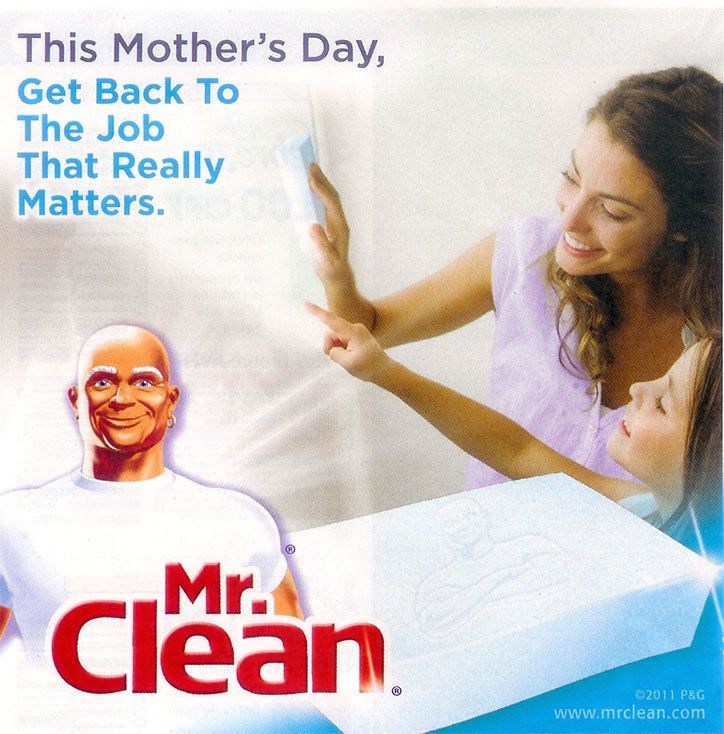
At first look, this ad seems wholesome enough. It is a mother teaching her child how to clean, clearly using Mr. Clean products, and seemingly having a grand old time. If you look further into it though, you can plainly see how this advertisement is blatantly gender stereotyping. It implies that there are apparently only two important jobs for women which are cleaning and taking care of their children. You would think that a large company such as Mr. Clean would do better not to make such generalizations about women or their place in their home and in the world.
Furthermore, it is clear what kind of message it also sends to mothers and their children. This ad gives the impression that women are meant to be in the home and teaching their daughters to know their place there too. The stereotype that women are the only ones responsible for cleaning in the household and they should be taught as such is out-dated and no longer accurate in today’s society. In my opinion, Mr. Clean can do much better than this.
GAP is taking steps in the wrong direction.
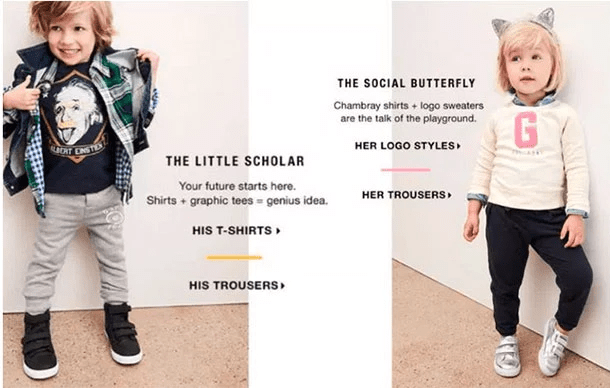
This more recent advertisement by GAP for their children’s clothing in the UK seems to be going back in time to out-dated stereotypes for both boys and girls. This advertisement is wrong on a number of levels. The ways that this enforces certain gender roles is borderline obscene. The advertisement is adorable at first glance, but its implications are not. It uses “little scholar” to describe the boy and it speaks to reinforce the idea that men are the “smart” ones and they should be focusing on their education and their goals. Boys, and men, are capable and allowed to be so much more than scholars.
Inversely, using the words “social butterfly” to describe the girl and her role or goals at school is most certainly a gender stereotype. The idea that girls, and women, are talkative and only care about social interaction or social comparison is not just a stereotype; it’s most-assuredly sexist. Women can be strong, smart, and driven and not just little “butterflies” who talk too much. That is certainly not the only thing they can be good at either. Women can be scholars and men can be social butterflies, there should be no reason for our society to still be stuck with the idea there is one role per gender.

Women are strong, in more ways than one.
This advertisement has a clever way of trying to draw people in and get them to shop at their website. It plays on the idea that you will buy so much that it will be heavy to lift the bags that you use (even though you are shopping on a website and not in a mall). However, it seems to be alluding to the idea that women love to shop. Which may or may not be true for some women, but this is generalization at its finest. Many generalizations about people of a certain sex, race, or religion are just stereotypes. This advertisement is definitely gender stereotyping.
Not only does this advertisement perpetuate the idea that only women love to shop, but it also seems to suggest that the only kind of exercise women do is shop. It is making a generalization about a woman’s ability to be strong and actually enjoy physical fitness. Many women, including myself, love to exercise and stay in shape. It is not just men who want to be strong and physically fit, and it is not just women who enjoy shopping for things they need or want.
Men are stereotyped too.
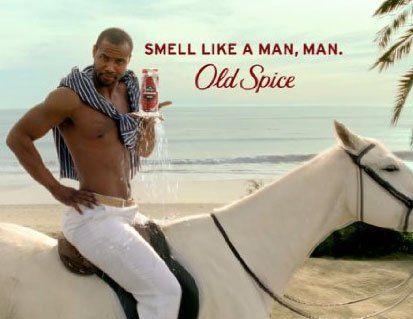
This advertisement definitely brings the sex appeal to body wash which is a tactic as old as time in the advertising business. For decades, women and men have been objectified for the gain of corporations. We do not seem to realize how this may affect those who do not fit the industry’s standards for attractiveness; this can seriously have an effect on mental health and eating disorders of average people because it creates unrealistic standards that people feel they must live up to.
This advertisement shows an physically fit man riding a horse on a beach, promoting Old Spice and saying, “Smell like a man, man.” The stereotype that all men must be strong, chiseled, and masculine is unhealthy. Men come in all shapes and sizes, and it is not up to companies to tell men that they must be manly in order to be accepted or be attractive. This perpetuates toxic masculinity and does not allow for men to feel like they can be accepted simply as they are or express themselves without fear of judgement. Advertisements can do better not to depict a one-size-fits-all body type for women and men alike.
 Gender Stereotypes in Advertisement